
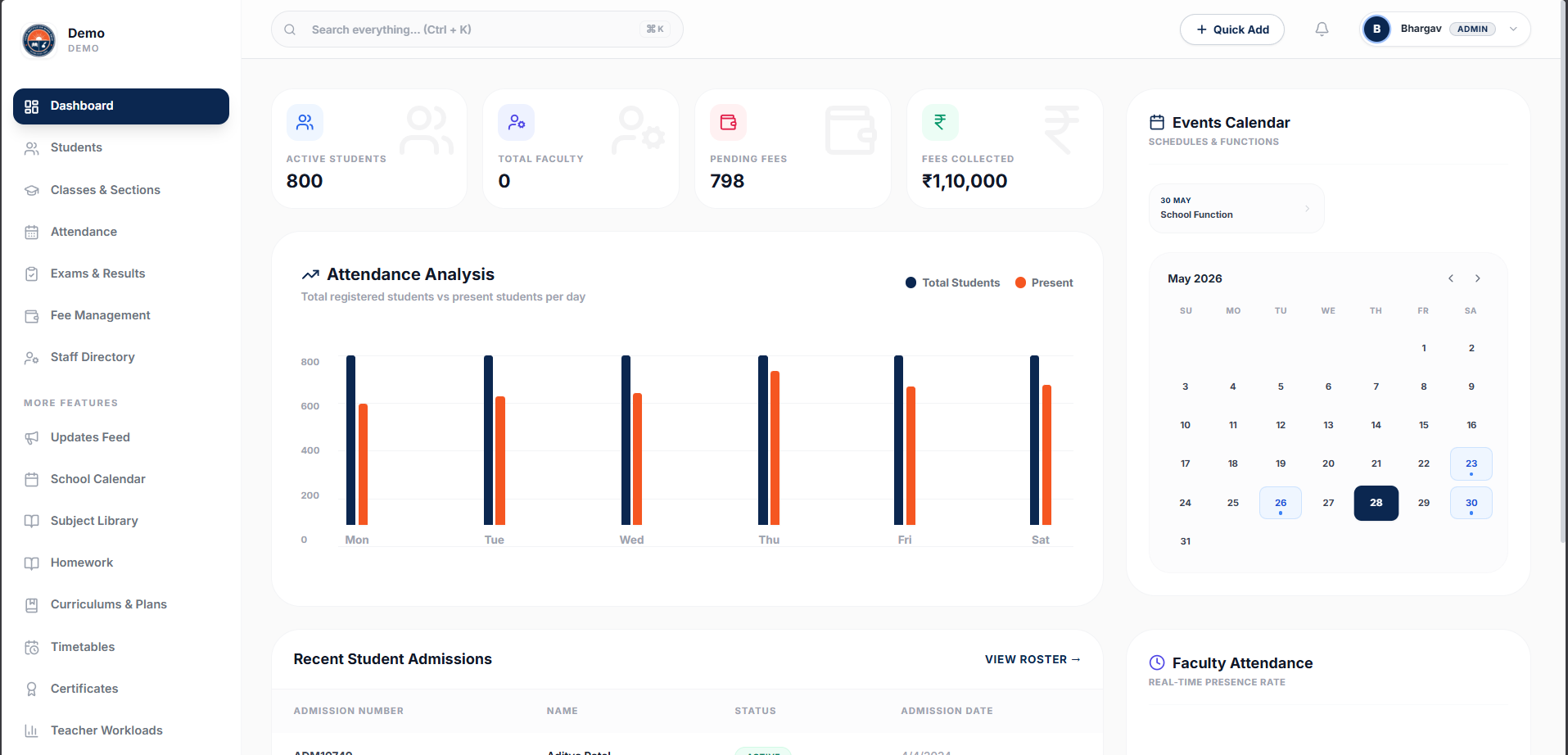
AogsiERP is a modern school operations platform built to simplify how schools manage attendance, fees, academics, staff, exams, and communication. Beyond traditional ERP systems, AogsiERP is being designed with an upcoming AI-powered scheduling and academic optimization engine that helps schools automate timetables, balance faculty workloads, detect staffing gaps, and improve operational efficiency without requiring enterprise-level budgets or complex AI infrastructure.
AogsiERP is a modern multi-tenant School Operations and Academic Intelligence Platform designed to help educational institutions centralize administration, streamline academic workflows, optimize resource utilization, and improve operational decision-making through intelligent automation and data-driven insights.
Built on a scalable cloud-native architecture, AogsiERP unifies student lifecycle management, faculty administration, academic planning, attendance tracking, examination management, financial operations, communication systems, access governance, and institutional reporting into a single integrated platform. The system eliminates fragmented workflows and disconnected software stacks by providing schools with a centralized operational ecosystem capable of supporting institutions of varying sizes and structures.
Roles and access
At its core, AogsiERP is designed around a role-driven operational framework that enables administrators, academic coordinators, finance teams, faculty members, students, and parents to interact with a unified system while maintaining strict access controls through a granular permission and authorization engine. The platform supports configurable role-based access management, hierarchical permissions, workload visibility, and operational governance, ensuring that every stakeholder has access only to the information and functionality relevant to their responsibilities.
Academic workflows
The platform's academic management infrastructure provides comprehensive support for student admissions, enrollment workflows, class and section administration, curriculum mapping, subject management, homework distribution, examination scheduling, results publishing, attendance tracking, academic records management, and institutional reporting. Faculty management capabilities include staff onboarding, workload allocation, class assignments, attendance monitoring, performance visibility, and workforce capacity planning, enabling institutions to maintain operational efficiency while balancing academic responsibilities across departments.
Scheduling in development
Beyond traditional ERP functionality, AogsiERP is being architected as an Academic Operations Intelligence Platform. The system is currently evolving to include a next-generation scheduling and optimization engine powered by constraint-based mathematical optimization models. Unlike conventional timetable generators that rely on static templates and manual adjustments, the upcoming scheduling engine is designed to evaluate thousands of operational constraints simultaneously, including teacher availability, subject requirements, faculty specialization, classroom allocations, laboratory utilization, academic calendars, curriculum pacing requirements, substitution safety thresholds, workload balancing objectives, and institutional scheduling policies.
The scheduling engine leverages deterministic optimization methodologies inspired by advanced Constraint Satisfaction and Operations Research techniques, enabling schools to generate operationally realistic timetables while maintaining transparency and explainability throughout the decision-making process. By combining optimization algorithms, resource allocation models, and institutional planning intelligence, the platform aims to assist schools in reducing scheduling conflicts, improving faculty utilization, identifying staffing gaps, and ensuring curriculum completion feasibility throughout the academic year.
To support long-term institutional planning, AogsiERP is also being developed with academic capacity analysis capabilities that extend beyond timetable generation. The platform is designed to evaluate instructional capacity, faculty demand, curriculum coverage requirements, resource utilization efficiency, substitution risk exposure, and operational bottlenecks across the institution. These capabilities enable administrators to make informed decisions regarding staffing, scheduling, infrastructure allocation, and academic planning based on measurable operational data rather than manual estimations.
Technology and operations
From a technology perspective, AogsiERP is built using a modern cloud-native stack focused on performance, scalability, reliability, and maintainability. The platform utilizes React and TypeScript for frontend experiences, NestJS for backend services, PostgreSQL for data persistence, Redis for caching and queue management, Prisma for database access, Docker-based containerization for deployment consistency, AWS infrastructure services for scalability, S3-based object storage for media assets, BullMQ-powered asynchronous processing pipelines, centralized logging through Pino, application monitoring through Sentry, and distributed service architecture principles designed to support future horizontal scaling requirements.
Security, observability, and operational resilience are foundational design principles throughout the platform. Multi-tenant data isolation, role-based authorization, centralized audit trails, structured logging, performance monitoring, automated backups, scalable storage infrastructure, and service-level fault isolation are incorporated to ensure reliability and maintain operational integrity as institutions grow.
The long-term vision of AogsiERP is to move beyond traditional school management software and become an institutional intelligence platform capable of assisting educational organizations in optimizing operations, improving resource allocation, reducing administrative overhead, and making better academic and operational decisions through intelligent automation and actionable insights.